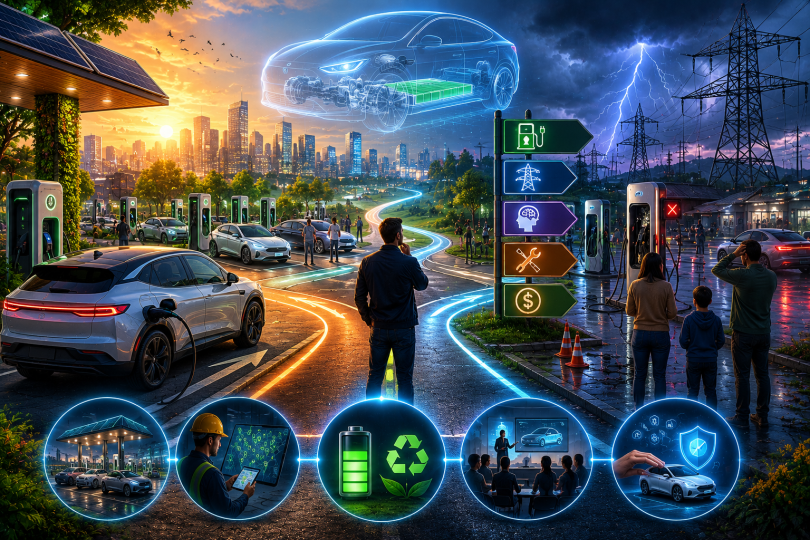

For years, range anxiety dominated conversations about electric vehicles. Concerns over battery capacity, charging frequency, and the fear of being stranded without power were often cited as the primary barriers to widespread adoption.
Today, however, the landscape looks markedly different.
Advances in battery technology have enabled many modern electric vehicles to achieve ranges that comfortably exceed typical daily driving requirements. Improvements in efficiency, charging speeds, and battery management systems have further reduced concerns that once defined the EV debate.
As a result, the conversation is beginning to shift. While range remains an important consideration, it is no longer the only—or even the most pressing—question facing the future of electric mobility. Instead, attention is turning towards a new set of challenges that could play a significant role in determining how quickly EV adoption continues over the next decade.
Charging Infrastructure Remains Uneven
Although electric vehicle technology has advanced rapidly, charging infrastructure has not always expanded at the same pace.
Many drivers now accept that modern EVs can comfortably cover long distances. The greater concern often revolves around where and how conveniently those vehicles can be recharged.
Urban residents without access to private driveways face particular challenges. While homeowners can often install domestic charging equipment, those living in flats or densely populated areas may depend heavily on public infrastructure.
Long-distance travel presents additional considerations. Although rapid charging networks continue to expand, consistency and accessibility remain important issues. Drivers want confidence that chargers will be available, operational, and compatible when needed.
As EV ownership grows, infrastructure development will likely become one of the most significant factors influencing consumer confidence.
Grid Resilience and Energy Demand
The widespread adoption of electric vehicles raises broader questions about energy systems.
As millions of vehicles transition from petrol and diesel to electricity, national grids will face increasing demand. While many experts believe this challenge is manageable, it requires careful planning, investment, and modernisation.
Smart charging technologies may play a crucial role in balancing demand. By encouraging charging during off-peak periods, utilities can reduce pressure on networks while improving overall efficiency.
Vehicle-to-grid technology is another area attracting attention. Future EVs may be capable of returning electricity to the grid during periods of high demand, effectively transforming vehicles into mobile energy storage systems.
These developments highlight an important reality: the future of electric mobility depends not only on automotive engineering but also on the evolution of energy infrastructure.
Consumer Education Still Matters
Despite increasing familiarity with electric vehicles, misconceptions remain widespread.
Many consumers continue to overestimate their daily driving requirements while underestimating the capabilities of modern EVs. Questions surrounding charging habits, battery longevity, maintenance costs, and ownership experiences can create uncertainty among prospective buyers.
Unlike traditional vehicles, electric cars introduce concepts that may be unfamiliar to some motorists. Charging speeds, battery degradation, regenerative braking, and software updates all represent relatively new considerations for many consumers.
Improving public understanding could prove just as important as technological progress itself.
As the market matures, manufacturers, governments, and industry organisations will likely need to focus more heavily on education alongside infrastructure expansion.
The Ownership Experience Is Becoming Increasingly Important
The first wave of EV adoption was often driven by early adopters who were willing to embrace new technologies despite occasional inconveniences.
Mainstream consumers tend to evaluate vehicles differently. They expect reliability, simplicity, and predictability throughout the ownership journey.
As a result, long-term ownership experiences are becoming increasingly important.
Questions surrounding battery warranties, repair costs, servicing networks, software support, and resale values are attracting greater attention. Consumers want reassurance that electric vehicles will remain practical and financially viable over many years.
This shift reflects a broader transition within the EV market. The discussion is moving away from novelty and towards everyday usability.
Software Is Becoming Part of the EV Equation
Many modern electric vehicles are as much software products as they are mechanical machines.
Over-the-air updates, connected services, battery optimisation systems, and digital interfaces have become central components of the ownership experience. In some cases, software improvements can enhance efficiency, charging performance, and usability long after a vehicle has been delivered.
This creates new opportunities but also new expectations.
Consumers increasingly expect their vehicles to evolve and improve over time. At the same time, manufacturers face growing responsibility for maintaining digital systems throughout a vehicle’s lifespan.
The success of future EV adoption may depend partly on how effectively manufacturers manage this ongoing relationship with owners.
Sustainability Questions Are Becoming More Sophisticated
Environmental considerations remain one of the primary motivations behind EV adoption. However, public conversations are becoming increasingly nuanced.
Consumers are now asking broader questions about battery production, raw material sourcing, recycling processes, and lifecycle emissions. Rather than focusing solely on tailpipe emissions, many people want a more comprehensive understanding of overall environmental impact.
This reflects a natural evolution in public awareness.
As electric vehicles become more mainstream, discussions are moving beyond simple comparisons between powertrains and towards a deeper examination of sustainability across the entire automotive ecosystem.
Manufacturers that address these concerns transparently may be better positioned to build long-term trust.
Personalisation and Automotive Identity Will Continue to Matter
Even as vehicles become more technologically sophisticated, motorists continue to view their cars as expressions of personal identity.
The rise of electric vehicles has not diminished interest in customisation, aesthetics, or individuality. If anything, new technologies are creating additional opportunities for personalisation through software settings, unique design features, and digital experiences.
Traditional forms of vehicle identity remain relevant as well. Businesses such as Number 1 Plates operate within a broader personalisation landscape that reflects motorists’ enduring desire to make their vehicles feel distinctive and representative of their individual tastes.
The future of EV ownership is likely to involve both technological innovation and personal expression.
Affordability May Become the Defining Issue
While infrastructure and education receive significant attention, affordability could ultimately prove to be the most influential factor affecting adoption rates.
Although operating costs are often favourable, the initial purchase price of many electric vehicles remains higher than comparable internal combustion alternatives.
As battery costs continue to fall and manufacturing scales increase, prices are expected to become more competitive. However, ensuring that EVs are accessible to a broader range of consumers will remain an important objective for manufacturers and policymakers alike.
Mass adoption requires more than technological capability—it requires economic accessibility.
Conclusion
Electric vehicles have reached a stage where range anxiety is no longer the defining issue it once was. Significant improvements in battery technology have shifted the conversation towards a more complex set of challenges that will shape the next phase of adoption.
Charging infrastructure, grid resilience, consumer education, software support, sustainability considerations, ownership experiences, and affordability are emerging as the factors most likely to influence future growth.
The success of electric mobility over the next decade will depend not only on how far vehicles can travel on a single charge, but also on how effectively the wider ecosystem evolves around them.
As the industry matures, the future of EV adoption may be determined less by the technology inside the vehicle and more by the systems, services, and experiences that support it.