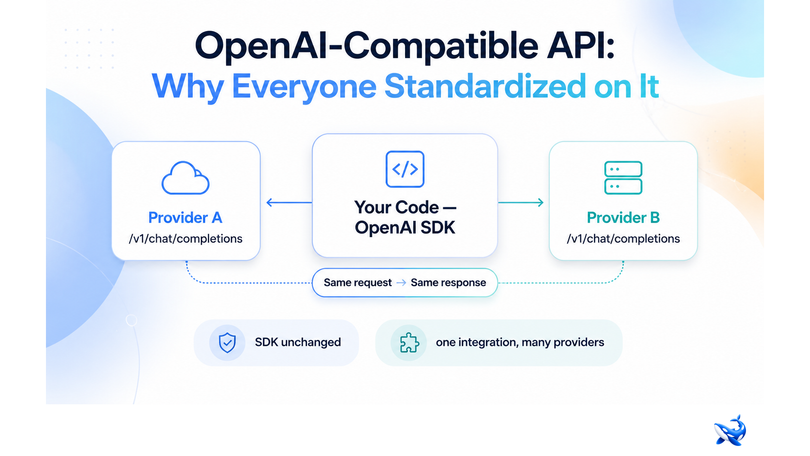

An ai gateway is an endpoint that speaks the same wire dialect as OpenAI’s own chat-completions service — the same messages array, the same stream flag, the same response envelope — so the official OpenAI SDK, in Python, TypeScript, or any of its ports, can talk to it with zero adapter code. It became the de-facto interface of the model economy because the switching cost is nearly zero: change the base_url, change the model string, and the rest of your integration stays untouched. We’ve looked at GPT-5.6 Terra as one model behind that dialect; this piece is the plain-language version — why the whole industry standardized on it, what it buys you, where the label stretches, and how to audit an endpoint’s fidelity before you trust it in production.
The claim you keep reading — “OpenAI-compatible,” on model pages and vendor docs alike — is a spectrum, not a binary. Nearly everything with that label passes a happy-path chat request, and the differences hide in the corners: streaming chunk shapes, tool-calling conventions, and parameters silently ignored rather than rejected. Before you point your SDK at yet another endpoint, it’s worth knowing what the label promises, what it doesn’t, and how to check the gap yourself.
What “OpenAI-compatible” actually means
The phrase describes a wire contract, not a brand. It means an endpoint accepts the same request shape OpenAI’s chat completions accept — the messages array with system/user/assistant roles, sampling knobs like temperature, token limits, and the stream flag — and returns the same response shape: choices[0].message.content, a usage block, and a finish_reason. Because the official SDKs (and their community ports) are built against that contract, any endpoint that honors it is reachable through the same client constructor with a different base_url and api_key.
That is why the integration is so small. Two providers that both speak the dialect need different credentials, but not different code:
“`python
from openai import OpenAI
client_a = OpenAI(
base_url=”https://api.provider-a.com/v1″,
api_key=os.environ[“PROVIDER_A_API_KEY”],
)
client_b = OpenAI(
base_url=”https://api.provider-b.com/v1″,
api_key=os.environ[“PROVIDER_B_API_KEY”],
)
for name, client in ((“a”, client_a), (“b”, client_b)):
resp = client.chat.completions.create(
model=”flash-mini” if name == “a” else “turbo”,
messages=[
{“role”: “system”, “content”: “You summarize carefully.”},
{“role”: “user”, “content”: “Summarize this changelog in three bullets.”},
],
temperature=0.2,
)
print(name, resp.choices[0].message.content)
“`
Two calls, one shape. The model string is the only per-provider difference in the request itself. This is the entire promise of the label: your request code, retry logic, and response parsing are written once, and “which provider” becomes configuration rather than a codebase fork.
Why it became the de-facto standard
Standards rarely win because they are technically best; they win because of network effects, and the OpenAI surface had the strongest network effect in the industry. The SDK ecosystem was already enormous — official Python and TypeScript clients, community ports in a dozen languages, framework integrations, evaluation harnesses, and observability tooling all built against one shape. A new model vendor that adopted that shape instantly became reachable by every developer who already had an OpenAI key in a .env file, with no migration, no second SDK, no learning curve. The cheapest way to distribute your model was to speak someone else’s dialect, so virtually everyone did.
The same dynamic favored buyers: adopting a second provider becomes a config change, not a project. Switching costs that would normally lock you to a vendor — retraining engineers, rewriting parsing, reworking failure handling — collapse to a single base URL. Sellers wanting reach plus buyers wanting optionality is why “OpenAI-compatible” stopped being a feature and became table stakes.
What it buys you: one integration, many models
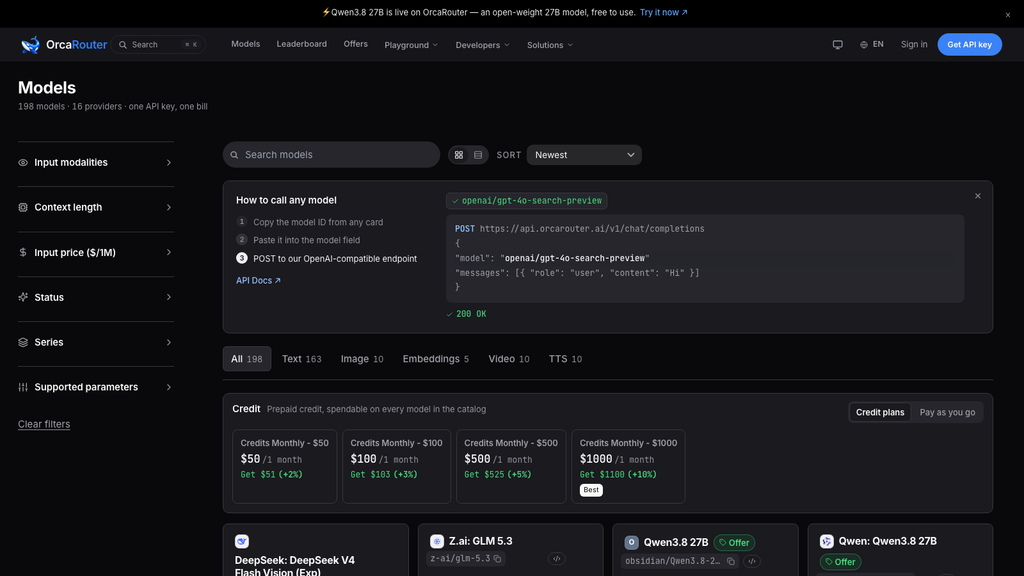
The payoff is concrete: one code path, one key, one error-handling policy, and one observability pipeline in front of whatever mix of models you want to call. Model selection becomes a decision your system makes per request instead of a choice you compiled into the codebase. This is also where the label stops being about a single vendor — once an endpoint speaks the dialect, it can front models from any provider that also speaks it. A single OpenAI-compatible endpoint can sit in front of a full catalog: OpenAI, Anthropic, Google, Meta, Mistral, xAI, DeepSeek, Qwen, GLM, MiniMax, and others, all behind one API key [OrcaRouter].
That is the shape of the modern setup: your application code talks to one OpenAI-compatible endpoint, and the endpoint’s job is deciding which underlying model answers. OrcaRouter exposes its whole catalog this way — an OpenAI-compatible endpoint backed by one key for 200+ models, with provider list prices passed through at 0% markup [OrcaRouter]. And because the dialect is uniform, routing, load balancing, and automatic failover happen behind the interface your SDK already knows; a provider that degrades hands the request to the next model that can answer, and your code never sees the swap.
Where “compatible” starts to stretch
The label is accurate about the happy path and loose about the edges. Four places in particular separate a faithful implementation from a marketing sticker.
Streaming nuances. Every streaming endpoint sends Server-Sent Events, but not all send the same chunks. Some include a final role-only chunk, some don’t; reasoning models push reasoning tokens through delta.reasoning_content in one implementation and delta.content in another. If you build a raw SSE consumer instead of leaning on an SDK, chunk shape is the first thing to diff between providers.
Tool-calling differences. Tool use is the least standardized part of the surface. Some endpoints expect the current tools array, some still accept the deprecated functions, and some handle parallel tool calls, tool_choice, or image input inside tool calls differently. A compatible endpoint can fail — silently — the day you add a tool.
Parameter gaps. max_tokens versus max_completion_tokens, seed, logprobs, frequency and presence penalties: some fields map cleanly, some are approximated, and some are accepted and ignored. A sampling knob that silently does nothing produces output that is subtly different and very hard to notice.
Silent tolerance. This is the dangerous one. A faithful endpoint rejects an unsupported parameter; a sloppy one swallows it and returns a plausible-looking answer. Your integration won’t crash — it will just behave differently than it would on the reference implementation, and you’ll debug it as a prompt problem for a week.
How to evaluate an endpoint’s fidelity
You can check most of the gap yourself with a small matrix of requests run through the official SDK against both the endpoint under test and a known-good reference. Send the same prompt through four doors: a plain chat completion, a streamed completion, a tool-calling request, and a request with an unsupported parameter. Faithful behavior is: identical content modulo model differences, a standard error envelope for the bad parameter, and streaming that terminates with [DONE]. Diff the outputs side by side rather than eyeballing them.
| What to test | What faithful looks like | What flags a gap |
| Plain chat | Same choices[0].message.content shape | Non-standard response envelope |
| Streaming | SSE chunks ending in [DONE] | Missing terminator or odd delta fields |
| Tool calling | tools array honored, tool_calls returned | JSON stuffed into plain text content |
| Bad parameter | Standard error object returned | Field accepted and silently ignored |
| Model IDs | provider/model strings resolve as documented | Aliases that drift between docs and reality |
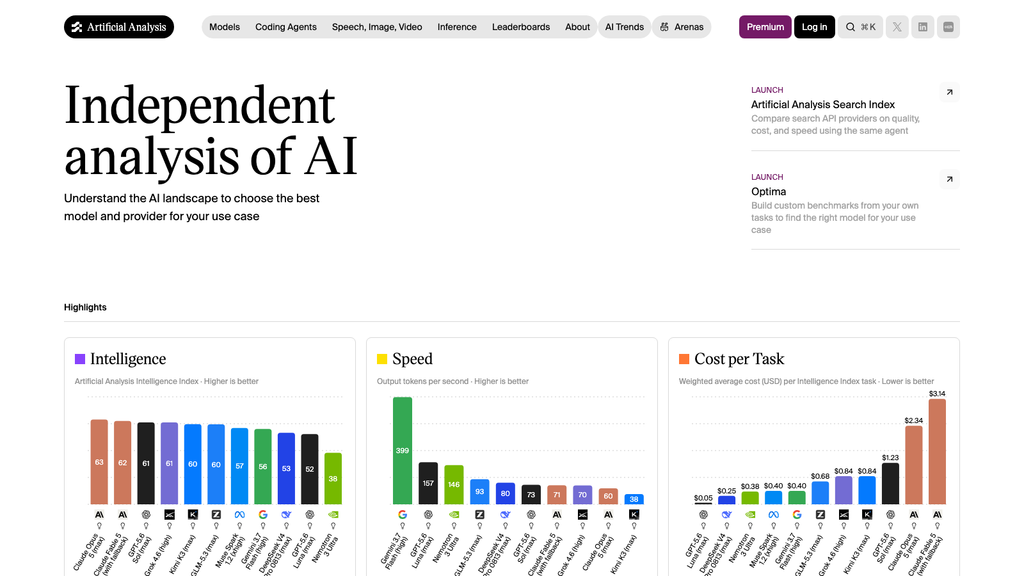
Then cross-check the economics with an independent source. Latency and price are the two claims most worth verifying outside the vendor’s own dashboard, and neutral leaderboards publish both for the same model across providers — check that the endpoint’s observed behavior and bill match the independent numbers, not just the vendor’s marketing page. Two screens, one afternoon, and the “compatible” label earns your trust or loses it.
The takeaway
An OpenAI-compatible API is for teams that want the economics of a multi-provider setup without the integration tax: one SDK, one key, and the freedom to move between models and providers as config rather than as a rewrite. It’s a poor fit only if you will call exactly one model forever and value nothing about optionality — in which case the label matters less than the model. For everyone else, the decision isn’t whether to use the dialect, it’s which endpoint deserves your key: one that speaks it faithfully on the happy path and the edges, passes provider prices through rather than marking them up [OrcaRouter], and keeps routing and failover behind the same interface your code already knows. Test the corners, diff the output, check the independent numbers — the label is the promise, fidelity is the deliverable.
Sourcing note: All product facts — one API key for 200+ models, the provider list (OpenAI, Anthropic, Google, Meta, Mistral, xAI, DeepSeek, Qwen, GLM, MiniMax), an OpenAI-compatible endpoint, 0% markup pass-through pricing, and automatic failover — come from the OrcaRouter homepage and product pages, checked August 22, 2026. The code example uses placeholder endpoints and keys; no third-party benchmark figures are used in this article.