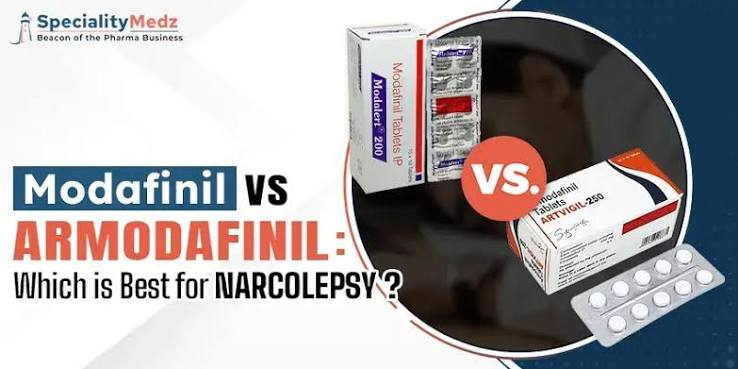

Ask ten people who have used both drugs whether armodafinil is stronger than modafinil and you will get a spread of answers. Some insist armodafinil hits harder. Others say modafinil gives a sharper peak and armodafinil just lasts longer. A few say they cannot tell the difference at all. The disagreement is not because people are imagining things; it is because “stronger” is doing a lot of work in that question, and the two drugs differ in ways that make a simple answer misleading.
This article takes the question apart. It looks at what the two molecules actually are, how milligram equivalence works, what “strength” means in terms of peak versus duration, and what the clinical data show. By the end, you should be able to answer the question for your own situation, which is the only version of it that really matters. If you are weighing armodafinil against modafinil for the first time, the milligram numbers on the packaging are the place where most confusion starts, so that is where we will begin.
The Chemistry: One Molecule, Two Mirror Images
Modafinil is a racemic mixture, meaning it contains equal parts of two mirror-image forms of the same molecule: R-modafinil and S-modafinil. These enantiomers have identical chemical formulas but different three-dimensional shapes, and the body treats them differently.
Armodafinil is simply the R-enantiomer on its own. It is not a different drug in any meaningful pharmacological sense; it is half of modafinil, isolated.
The reason this matters comes down to clearance. S-modafinil has a half-life of roughly 3 to 4 hours. R-modafinil has a half-life of roughly 15 hours. When you take a 200 mg modafinil tablet, you are taking about 100 mg of the fast-clearing form and 100 mg of the slow-clearing form. Within a few hours, most of the S-form is gone, and what remains circulating is essentially armodafinil.
This single fact explains almost everything about how the two drugs compare.
Milligram Equivalence: Why 150 Is Not Less Than 200
The most common point of confusion is that armodafinil’s standard dose is 150 mg while modafinil’s is 200 mg, which makes armodafinil look like a “lower” dose. It is not.
Because armodafinil is 100% active R-enantiomer, and modafinil is 50% R-enantiomer, a 200 mg modafinil tablet delivers about 100 mg of R-modafinil. A 150 mg armodafinil tablet delivers 150 mg of R-modafinil. Milligram for milligram of the long-acting component, armodafinil 150 mg contains 50% more than modafinil 200 mg.
The catch is that the S-enantiomer is not inert. It contributes to the early effect during its short window, so the first few hours after a modafinil dose have both forms working together. This is why modafinil can feel like it comes on with a slightly sharper peak, even though its long-acting content is lower.
A rough equivalence table
| Modafinil dose | Approximate armodafinil equivalent | Notes |
| 100 mg | 50–75 mg | Both mild; armodafinil version lasts longer |
| 200 mg | 150 mg | The standard clinical comparison |
| 400 mg | 250 mg | Modafinil 400 mg is off-label; armodafinil 250 mg is the labeled ceiling |
These equivalences are approximate and are based on peak plasma concentration of the R-enantiomer, which is what clinicians typically use when switching patients between the two.
Strength as Peak Intensity
If “stronger” means “the most noticeable effect at the moment of peak,” the two drugs at their standard doses are roughly comparable, with a slight edge that depends on the individual.
Pharmacokinetic studies comparing armodafinil 200 mg to modafinil 200 mg found that armodafinil produced higher plasma concentrations in the later part of the day, while early concentrations were similar. At the standard clinical doses (150 mg versus 200 mg), the early peaks are close. Some users perceive modafinil’s peak as sharper because of the S-enantiomer contribution; others perceive armodafinil’s as cleaner because there is no fast-fading component muddying the signal.
Subjectively, people who describe armodafinil as “stronger” are usually noticing one of two things: a more sustained level of alertness through the afternoon, or a noticeable effect at a dose number that sounds small. People who describe modafinil as stronger are usually noticing the early peak.
Strength as Duration
If “stronger” means “lasts longer,” armodafinil wins clearly and unambiguously.
Because it contains no fast-clearing component, armodafinil’s plasma curve is a long, relatively flat plateau. A 150 mg dose at 7 a.m. maintains a clinically meaningful concentration through the early evening. Modafinil 200 mg at the same time shows a similar early level but declines more noticeably by mid-afternoon as the S-enantiomer disappears.
In practical terms:
- Modafinil 200 mg: felt effect roughly 8–12 hours, with a perceptible softening after 6–8 hours
- Armodafinil 150 mg: felt effect roughly 10–14 hours, with a more gradual decline
For someone who needs alertness across a long day, this difference is the whole reason armodafinil exists as a product. For someone who needs to be sharp for a few hours and then sleep normally, it is a disadvantage.
Strength as Side-Effect Burden
Here the comparison flips in an interesting way. Because armodafinil delivers more of the long-acting enantiomer, its late-day plasma levels are higher, and the side effect most tied to late-day levels, insomnia, is somewhat more likely. Headache rates are broadly similar between the two. Anxiety and jitteriness, when they occur, tend to be associated with the early peak, and reports are mixed on which drug is worse.
Clinical trial adverse-event rates for the two drugs at their standard doses are close enough that neither is clearly better tolerated overall. The difference is in the pattern: modafinil’s side effects cluster earlier, armodafinil’s extend later.
What the Clinical Trials Actually Show
Both drugs have been tested extensively in narcolepsy, obstructive sleep apnea, and shift work disorder. Head-to-head trials are limited, but the available evidence supports a few conclusions:
- Both significantly improve objective wakefulness and subjective sleepiness compared with placebo
- Armodafinil shows a modest advantage in late-day wakefulness measures, consistent with its pharmacokinetics
- Neither drug shows a meaningful advantage over the other in early-day measures
- Cognitive performance improvements, where measured, are similar in magnitude
- Discontinuation rates due to adverse effects are low and similar for both
The honest summary is that armodafinil is not a “more powerful” drug so much as a “longer” one. It has the same mechanism, primarily dopamine transporter inhibition with downstream orexin and histamine effects, and produces the same kind of alertness.
Who Should Prefer Which
The choice comes down to the shape of your day rather than the abstract strength of the drug.
Armodafinil is likely the better fit if:
- You need coverage across a 12-hour or longer wake period
- You experience a noticeable afternoon crash on modafinil
- You are a night-shift worker who needs alertness through the drive home
- You can reliably dose within an hour of waking
Modafinil is likely the better fit if:
- Your demanding hours are concentrated in the morning
- You are sensitive to insomnia
- You want flexibility to dose a bit later without wrecking sleep
- You prefer a slightly more noticeable onset
Neither choice is wrong. Many people try both and settle on the one whose duration matches their schedule.
Switching Between the Two
If you move from modafinil to armodafinil, do not match the milligram number. A 200 mg modafinil user should start at 150 mg armodafinil, not 200 or 250 mg. Going the other direction, a 150 mg armodafinil user should start at 200 mg modafinil.
Also be aware that the first few days on armodafinil after modafinil may feel like the effect is “stretched” rather than intensified. The later-day alertness is new, and some people initially mistake it for the drug being stronger. Give it a week before judging.
A brief note on responsible use: both modafinil and armodafinil are prescription medications and Schedule IV controlled substances in the United States, and regulations vary by country. Neither is a replacement for sleep, and anyone with cardiovascular or psychiatric conditions should consult a doctor before use. Whichever smart drug you choose, the question of duration matters more than any perception of raw power.
FAQ
Is armodafinil 250 mg stronger than modafinil 400 mg? They are roughly comparable in R-enantiomer content. Modafinil 400 mg contains about 200 mg of R-modafinil plus 200 mg of S-modafinil; armodafinil 250 mg contains 250 mg of R-modafinil. The armodafinil dose lasts longer; the modafinil dose has a bigger early peak. Neither is a good starting point for anyone.
Why does armodafinil feel stronger to me at a lower milligram number? Because the milligram number counts inert enantiomer in modafinil but not in armodafinil. 150 mg of armodafinil contains more of the active long-acting form than 200 mg of modafinil does.
Does armodafinil work faster? No. Both take about one to two hours to reach a noticeable effect and two to four hours to peak. Absorption is similar.
Can I take a lower dose of armodafinil to get a “modafinil-like” experience? A lower armodafinil dose reduces intensity but does not shorten the duration much, because half-life is independent of dose. If you want a shorter effect, modafinil itself is the better tool.
Is one more likely to cause tolerance? Neither shows the rapid tolerance seen with amphetamines. Some users report mild softening of effect with daily use of either drug, and periodic breaks help. There is no strong evidence that one is worse than the other on this front.
Final Thoughts
Is armodafinil stronger than modafinil? In terms of long-acting drug per milligram, yes, which is why its standard dose is lower. In terms of peak intensity at standard doses, they are close. In terms of duration, armodafinil is clearly longer. In terms of side effects, they are comparable but distributed differently across the day. The right question is not which drug is stronger, but which drug’s curve matches the hours you need to be alert. Answer that, dose accordingly, and either one will do the job.
For more topic guides and related resources, visit Modavance.